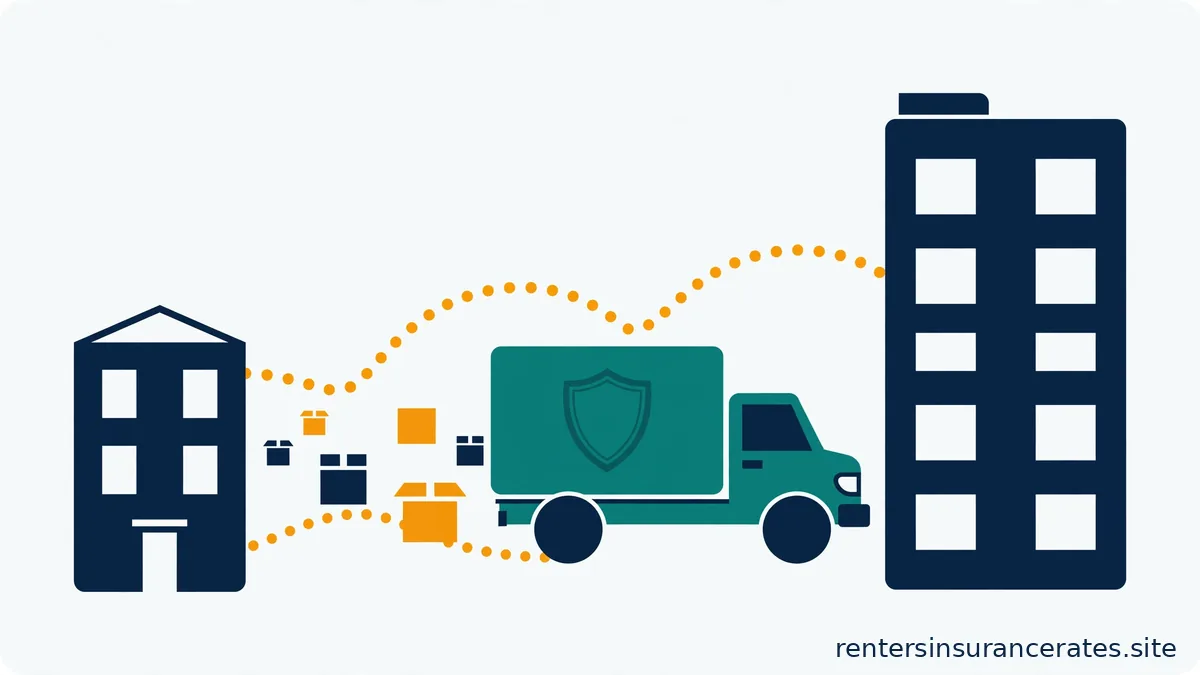
Yes. Call your insurer two weeks before the move, give them the new address and move-in date, and keep the old policy active until the new coverage is confirmed in writing. Update your limits for the new place, then cancel the old policy only after the new one is in force.
Key Takeaways
- Transfer, don’t cancel. Most insurers let you update your address on the same policy, which keeps your claims history and renewal date intact.
- Call 2–4 weeks before moving day. Some insurers can backdate or schedule the change, but same-day address changes can leave a coverage gap.
- A new ZIP means a new rate. Location is one of the biggest rating factors — even a move across town can shift your premium.
- Overlap beats a gap. Keep the old address on record until the new policy is confirmed in writing; cancel only after the new coverage starts.
- Your new lease may require proof of insurance. Ask your landlord what liability limits they require before you sign.
30 Days Before the Move: Tell Your Insurer What Is Changing
The biggest mistake renters make during a move is treating insurance as a moving-day errand. It is a paperwork task that belongs on the early list, alongside change-of-address forms and utility transfers. The reason is simple: your policy is tied to the address on the declarations page. If something happens in the new apartment before the insurer knows you live there, the claim can get messy — and a move is already one of the highest-risk windows for loss and theft.
Call your insurer or open the address-change flow in their app about 30 days out. You are not asking for a new policy; you are asking to endorse the existing policy to a new address. Almost every national carrier — State Farm, Allstate, Progressive, Lemonade, USAA, Amica, and others — handles this as a routine update rather than a rewrite. That matters because keeping the same policy preserves your continuous coverage history, which some carriers reward, and avoids a brand-new policy’s first-term pricing.
On the call, have three things ready: the new address, the exact move-in date, and the lease start date. The move-in date and lease start date are not always the same, and the insurer will generally use the date you take possession. Also ask whether the carrier covers your belongings during the move itself — most standard HO-4 policies cover personal property in transit between locations for a limited window, but the details vary by carrier, so get it in writing.
While you are at it, ask for a revised declarations page showing the new address and the effective date of the change. A declarations page is the one-page summary of your coverages, limits, and premium. Your new landlord may ask for proof of insurance before handing over keys, and most require at least $100,000 in personal liability as a lease condition — the common standard across rental leases nationwide.
2 Weeks Before: Rebuild Your Coverage for the New Place
A new apartment is rarely a copy of the old one. Bigger or smaller, ground floor or fifth floor, different neighborhood — all of it feeds into what coverage you actually need and what it will cost. Use the move as a forced review of your policy.
Re-estimate your belongings. This is the number that drives your personal property limit. If you bought furniture, electronics, or a closet full of new clothes since the last time you looked at your policy, your current limit may be stale. MoneyGeek’s 2026 rate analysis found the national average policy with $20,000 in personal property and $100,000 in liability costs $15 per month ($182 per year) — a useful benchmark, but the right number for you comes from a room-by-room inventory of what you actually own (MoneyGeek). When you are unsure how much renters insurance coverage you need, the inventory is always step one, not the quote.
Check the new building’s features. A doorman building, a gated complex, smoke detectors, deadbolts, and sprinkler systems can each qualify for small discounts with many carriers — MoneyGeek notes security devices can save 5% to 15% depending on the insurer (MoneyGeek). Tell your insurer about every one of them. Conversely, an older building with outdated wiring or a top-floor unit in a storm zone can push the rate the other way. These are the factors that affect your renters insurance rate, and a move reshuffles most of them at once.
Match the liability limit to the new lease. Read the new lease’s insurance clause carefully. Landlords can legally require renters insurance as a lease term — no federal or state law mandates it, but a lease clause is enforceable and breaching it can lead to fees or eviction. If the new lease asks for $100,000 in liability and the landlord listed as an “interested party,” get that wording to your insurer so the certificate is issued correctly. You can read more about how this works in our guide to whether your landlord can require renters insurance.
Moving Week: Run Two Policies, Not Zero
Here is where the coverage gap happens. Your lease on the old place ends on the 31st, your new lease starts on the 1st, and your stuff sits in a truck, a storage unit, or split between both apartments for a few days. The instinct is to end the old policy on the 31st and start the new one on the 1st. The safer move is to overlap them by a few days.
Most insurers will let the old-address coverage and the new-address endorsement coexist briefly — or will simply move the policy to the new address on your move-in date while your old apartment’s remaining days wind down. What you must not do is have a date where neither address is covered. A claim filed for a date with no active coverage at the relevant address is an uphill fight you do not want.
If your belongings spend a night or two in a storage unit, note that most policies cap off-premises theft coverage at around 10% of your personal property limit — so a $20,000 policy typically covers about $2,000 of theft from a storage unit or car, per InsureDBetter. Valuable items should ride in your own car, not in an unattended truck overnight.
Practical checklist for moving week:
- Photograph or video your belongings before the truck is loaded. A quick room-by-room walkthrough with your phone becomes your inventory and your claim documentation in one.
- Keep receipts for big-ticket items accessible — not packed at the bottom of a box. If a laptop is stolen during the move, you will need proof of purchase.
- Confirm the new address is on the declarations page before moving day, and save the insurer’s claims number in your phone.
- File a police report immediately if anything is stolen during the move — insurers generally require a report number for theft claims, and filing late weakens the record.
After Move-In Day: Confirm, Then Cancel
Once you are in the new place and the new coverage is confirmed in writing, cancel or end the old-address portion of the policy. Do this in this order — confirmed first, canceled second. If your insurer requires a written cancellation request, send it and keep the confirmation. If you paid the annual premium up front, ask about a prorated refund for the unused days; most carriers refund the remainder, though some charge a small short-rate fee for mid-term cancellation.
Then finish the admin loop:
- Send the new landlord proof of insurance with the correct address and the liability limit the lease requires.
- Update your address everywhere else the insurer touches — billing, autopay, and any bundled policies. If you bundle renters with auto insurance, update the garaging address on the auto policy too; a mismatched address can complicate an auto claim.
- Redo the inventory in the new space within the first month. You will never again have a moment where you know exactly where everything is.
- Re-shop if the new rate stings. A new ZIP can move your premium in either direction. MoneyGeek found rate differences of $50 or more between ZIP codes in the same state, and gaps of $100 to $150 between the cheapest and most expensive quotes for identical coverage (MoneyGeek). If your renewed rate jumps, comparing at least three quotes is the fastest way to check whether the increase is your carrier or your new neighborhood.
How a New ZIP Changes Your Rate
Renters insurance is priced heavily on location. Insurers look at local property crime rates, weather and catastrophe exposure, fire-protection class, and even the density of the neighborhood. MoneyGeek’s 2026 data shows the spread clearly: Wisconsin averages $112 per year while Louisiana averages $338 per year for the same $20,000/$100,000/$1,000-deductible profile (MoneyGeek). That is a state-level gap, but the same rating logic applies at the ZIP level.
This means your premium at the new address will almost certainly differ from the old one — possibly by a little, possibly by a lot. A move from a quiet suburb to a dense downtown with higher burglary rates can raise your rate even if nothing else changes. A move the other direction can lower it. Neither outcome means the insurer is punishing you; it is the same location factor that was already in your old premium, recalculated for the new risk profile.
Two things worth knowing about the new-rate math:
- The base profile resets. Insurers quote the new address as a new rating exercise. Your claims history, credit-based insurance score (used in most states), and deductible carry over, but the location component is rebuilt from scratch.
- Discounts do not always transfer automatically. Security-device discounts, gated-community discounts, and protective-device credits apply to the property, not to you. Tell your insurer about the new building’s features or you may pay for discounts you qualify for but never claimed.
Frequently Asked Questions
Do I need a new renters insurance policy when I move? Usually not. Most insurers let you transfer the existing policy to the new address with an endorsement, keeping your policy number, renewal date, and coverage history. A genuinely new policy is only needed if your current carrier does not write policies in the new state or the new property is ineligible.
Can my insurer refuse to cover the new apartment? It can happen — a carrier may not be licensed in the new state, or the building may fall outside its underwriting guidelines. If so, get the refusal in writing, then shop for a new policy before the move. Never let the old policy lapse before the new one is bound.
Will transferring my policy change my premium? Very likely yes, in one direction or the other. The new ZIP code, building age and construction, local crime rates, and any changes you make to limits or deductible all feed the new premium. Ask your insurer for the new premium quote before the move so there are no surprises.
What happens to my belongings during the move itself? Most HO-4 policies extend personal property coverage to your belongings while in transit between the old and new residence for a limited period, and to temporary storage. Confirm the details and any time limits with your insurer before moving day — do not assume.
Should I cancel the old policy on moving day? No — cancel only after the new address coverage is confirmed in writing. A few days of overlap costs almost nothing and protects you against the single most common moving insurance problem: a loss that falls in a gap between policies.
Rate figures in this article were verified in September 2026. Your actual premium depends on your state, ZIP code, coverage choices, credit-based insurance score, and carrier — get current quotes before buying, and talk to a licensed agent in your state if you are unsure how much coverage you need.