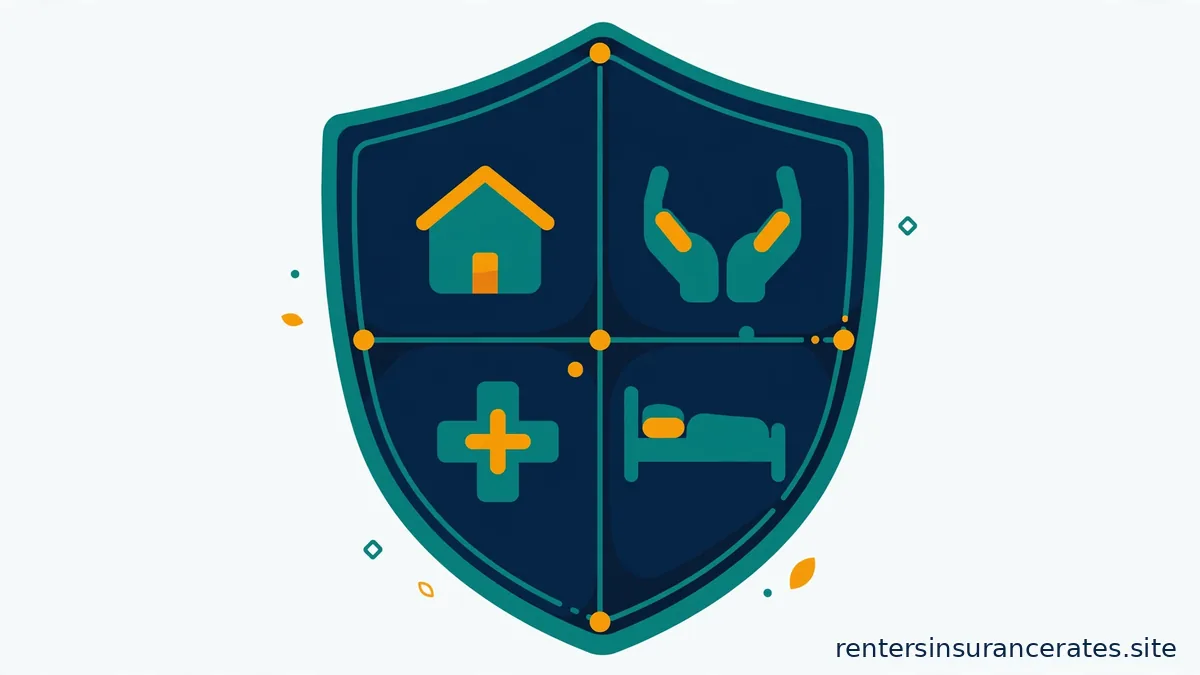
A standard renters insurance policy — technically called an HO-4 policy — bundles four distinct protections into one contract. Most renters only think about the first one (their stuff), but the other three are doing just as much work. Here’s a missplain-English tour of all four, with the everyday scenarios each one is built for.
Key Takeaways
- Four protections: personal property (your belongings), personal liability (harm you cause others), medical payments to others (guest injuries, no fault needed), and loss of use (hotel/meals if you’re displaced).
- Typical limits: $20,000+ for property, $100,000+ for liability, ~$1,000 for medical payments, $3,000–$5,000 for loss of use (InsureDBetter).
- Coverage applies to named perils: fire, theft, vandalism, wind/hail, lightning, and others — not everything that can go wrong (NY DFS).
- Your belongings are covered away from home too — but usually capped at 10% of your property limit.
- Flood and earthquake are not covered by standard policies. See what renters insurance does NOT cover.
Protection 1: Personal Property — Your Stuff
What it does: pays to repair or replace your belongings — furniture, clothes, electronics, appliances, sports equipment — when they’re stolen, damaged, or destroyed by a covered cause. Typical limits start at $20,000 and up (InsureDBetter).
Everyday example: your bike is stolen from the rack outside your building. Or a kitchen fire destroys your couch, clothes, and laptop. Personal property coverage reimburses you up to your limit, minus your deductible.
The part most renters miss: coverage follows your belongings outside the apartment. The NY DFS confirms that if your laptop is stolen from your car or your bike is taken from the rack at work, your renters policy may pay to replace them. The catch is the off-premises cap: most HO-4 policies limit away-from-home losses to 10% of your personal property limit — on a $30,000 policy, that’s $3,000 (InsureDBetter). This includes stolen packages and porch theft.
Named perils — what’s actually covered: renters insurance works on a named-peril basis, meaning the cause of loss must be on the list. Per the NY DFS, standard coverage includes fire, smoke, theft, vandalism, windstorm or hail, lightning, explosion, falling objects, weight of snow/ice/sleet, accidental water discharge (plumbing or appliance failure, fire sprinklers), and electrical surges. If the cause isn’t named and isn’t an added endorsement, it’s not covered.
Two fine-print items: first, certain categories have sub-limits — jewelry theft, for example, is typically capped around $1,500 per claim regardless of your total limit (per the III, cited by Compare.com). Expensive items need to be scheduled separately. Second, your payout depends on whether you chose actual cash value (depreciated) or replacement cost (new-for-old) — see our ACV vs. replacement cost guide for the math.
Protection 2: Personal Liability — Harm You Cause Others
What it does: covers costs if you’re found legally responsible for injuring someone or damaging their property — including legal defense, court fees, and settlements, up to your limit. Typical limits start at $100,000 (InsureDBetter); SoFi’s overview notes policies allow limits up to $500,000.
Everyday example: your bathtub overflows and ruins the ceiling of the apartment below. Or your dog bites a guest. Or a visitor trips over your rug and breaks a wrist — and decides to sue. Liability coverage handles the legal costs and the damages you’re found liable for.
Why it matters more than people think: property claims are bounded by what you own; liability claims are bounded by what a court awards. That’s why Liberty Mutual advises most tenants to carry at least $100,000 — and why landlords commonly require it in the lease. If you have meaningful savings, raising this limit is one of the cheapest upgrades available (about a 7% premium increase to go from $100k to $300k, per ValuePenguin).
What it doesn’t cover: injuries or damage to you, your household members, or your own property — and intentional acts. Liability is strictly about third parties. And your landlord’s building damage from your negligence may involve both your liability coverage and your landlord’s own policy — which is exactly the kind of overlap to discuss with a licensed agent in your state.
Protection 3: Medical Payments to Others — Guest Injuries, No Lawsuit Required
What it does: pays medical expenses when a guest is injured on your property — typically around $1,000 (InsureDBetter; ValuePenguin’s 2026 profile also uses $1,000). The key distinction from liability: it pays regardless of whether you’re at fault, and no lawsuit is needed.
Everyday example: a friend cuts their hand badly on your kitchen knife while helping you cook, and needs stitches at urgent care. Medical payments coverage handles the bill quickly, without anyone establishing liability. SoFi describes it as covering guests’ medical costs where liability coverage doesn’t require you to be legally liable.
Why it exists: small injuries shouldn’t become lawsuits. This coverage resolves the minor stuff fast and keeps neighborly relationships intact. It doesn’t cover your own household members’ injuries — only guests and other third parties.
Protection 4: Loss of Use — When You Can’t Live There
What it does: pays your additional living expenses — hotel, takeout meals, extra transportation — if a covered loss makes your rental temporarily uninhabitable. Typical limits run $3,000–$5,000 (InsureDBetter). Apartment List frames it as covering costs above your normal living expenses while you’re displaced.
Everyday example: a fire in your building leaves your unit smoke-damaged and unlivable for three weeks during repairs. Loss of use covers the hotel and the meals out — the extra costs beyond what you’d normally spend on rent and groceries.
Important boundary: it only triggers for covered losses. If you’re displaced by a flood — which standard policies exclude — loss of use doesn’t pay either. The coverage follows the peril, not the inconvenience. (See what’s excluded for the full list.)
How the Four Fit Together: One Scenario
A kitchen fire starts while you’re cooking. It destroys your appliances, cabinets’ contents, and clothes in the next room (personal property). Smoke forces you into a hotel for two weeks (loss of use). Your guest inhales smoke and needs an ER visit (medical payments). The fire spreads to the unit below, and that neighbor sues for their ruined belongings (personal liability). One event, four coverages, each doing its job.
That’s the real value of the HO-4 bundle: it’s not four separate products, it’s one policy where the protections interlock around a single bad day.
What to Check Before You Buy
- Confirm all four are present — standard policies include them, but limits vary. Make sure liability meets your lease’s minimum.
- Read the named perils and the exclusions — flood, earthquake, wear and tear, and pests are the standard gaps (Apartment List’s exclusion rundown).
- Size property coverage to an inventory, not a guess — our guide on how much coverage you need walks through the method.
- Ask about replacement cost vs. actual cash value — it changes every property payout (our comparison).
Coverage details vary by carrier and state, and this is general information — when you’re choosing limits, talk to a licensed agent in your state.
How to Read Your Four Limits on the Declarations Page
Every policy comes with a declarations page (the “dec page”) — usually the first page of your policy documents. It’s where the four protections show up as numbers. Here’s what to look for:
- Coverage C – Personal Property: your belongings limit ($20,000, $30,000, etc.). Check whether it says “replacement cost” or “actual cash value” next to it — that one phrase changes every property payout.
- Coverage E – Personal Liability: your liability limit ($100,000, $300,000, etc.). Confirm it meets your lease’s minimum.
- Coverage F – Medical Payments to Others: usually $1,000–$5,000. Small, but confirm it’s there.
- Coverage D – Loss of Use / Additional Living Expenses: often expressed as a dollar amount or a percentage of Coverage C.
Also on the dec page: your deductible (per claim, not per year), your named insureds (who’s covered — check this if you have roommates), and any endorsements (scheduled jewelry, earthquake, water backup). If any of the four coverages is missing or the numbers don’t match what you asked for, that’s a call to your agent before anything goes wrong — not after.
Named Perils, Explained in Plain English
The NY DFS lists the perils a standard renters policy covers. In everyday terms:
| Peril | What it means in practice |
|---|---|
| Fire and smoke | Kitchen fire, smoke damage to clothes and furniture |
| Theft | Break-in, stolen bike, pickpocketed phone |
| Vandalism | Someone smashes your windows or defaces your door |
| Windstorm / hail | Storm blows a tree into your windows; hail shatters them |
| Lightning | Surge fries your electronics (also: electrical surge peril) |
| Explosion | Gas explosion damages your unit |
| Falling objects | Tree limb through the roof onto your belongings |
| Weight of snow / ice / sleet | Roof load collapses onto your stuff |
| Accidental water discharge | Burst pipe, appliance failure, fire sprinklers going off |
| Electrical surge | Power spike destroys your TV and computer |
Two things to notice: water here means sudden plumbing failures, not weather flooding — that’s the flood exclusion. And anything not on this list (earthquake, flood, pests, wear and tear) needs a separate endorsement or policy, or it isn’t covered at all. See what’s excluded for the full gap list.
FAQs
Does renters insurance cover my roommate’s belongings?
Generally no — an unrelated roommate isn’t automatically covered just because you share an address. Whether a roommate can be added depends on the insurer and state rules (Apartment List). Confirm who qualifies as an insured person before assuming.
Does renters insurance cover theft outside my home?
Yes, usually — theft is a named peril and coverage extends off-premises, but it’s capped at about 10% of your personal property limit. On a $30,000 policy, that’s $3,000 for items stolen from your car, at work, or while traveling.
Is liability coverage really necessary if I’m careful?
Careful doesn’t cover accidents — an overflowing tub, a dog nip, a guest’s fall. Liability claims are the one category where costs can exceed everything you own, which is why leases commonly require at least $100,000. At the typical premium, it’s the cheapest catastrophic protection in the policy.
What’s the difference between medical payments and liability?
Medical payments cover guests’ injuries without establishing fault and without a lawsuit — fast, small, simple. Liability covers costs when you’re found legally responsible, including lawsuits, legal defense, and larger settlements. They complement each other.
Does the HO-4 cover my car?
No. Damage to or theft of your vehicle falls under auto insurance. But belongings stolen from your car (a laptop in the back seat) can fall under your renters policy’s personal property coverage, subject to the off-premises cap. The car and the stuff inside it are two different insurance questions.